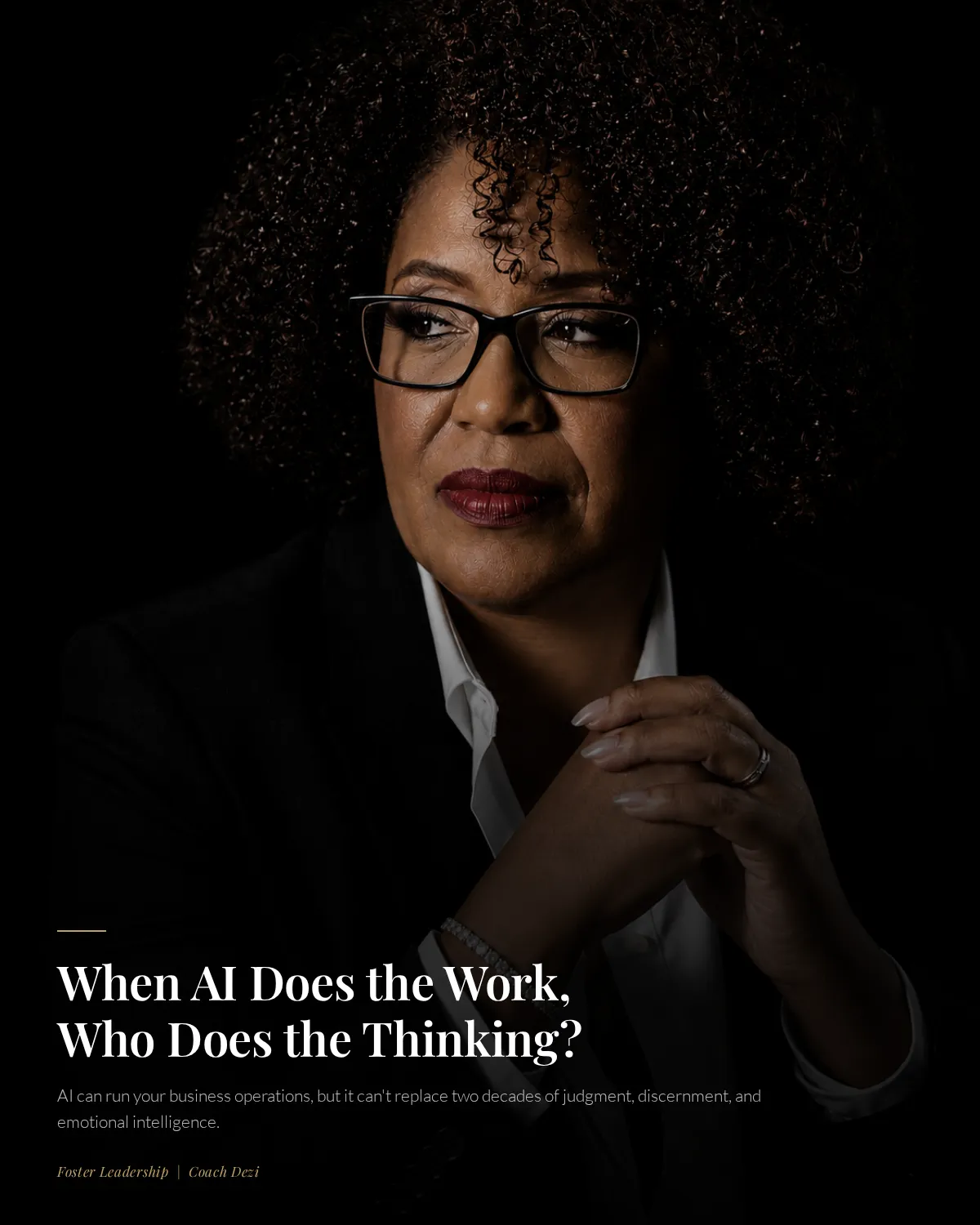
When AI Does the Work, Who Does the Thinking?
You've probably heard it by now. AI can write your emails, build your website, run your social media, schedule your calendar, and draft your business plan before you finish your morning coffee.
And if you're a woman who spent 20-plus years in corporate, managing teams and running operations and solving problems that didn't have names yet, you might be looking at all of this and thinking: "So what exactly is my value now?"
That's the question nobody's talking about honestly. Because the tech industry wants to sell you on speed. On efficiency. On doing more in less time. And listen, I'm not against any of that. I use AI every day. I built part of my business with it. But there's a difference between using a tool and being replaced by one. And the women I work with are smart enough to know the difference, even if the market isn't making it easy to see.
The Real Conversation We Should Be Having
McKinsey published a report in early 2025 estimating that generative AI could automate up to 30% of hours currently worked in the U.S. economy by 2030. That's not a future prediction anymore. It's happening in real time. Companies are restructuring. Roles are consolidating. And a lot of the women getting pushed out aren't being pushed out because they weren't good at their jobs. They're being pushed out because someone decided a bot could do it cheaper.
But here's what I've seen in the conference room and in the coaching room: the women who thrive through this shift aren't the ones who learn the most tools. They're the ones who know what no tool can replicate.
Judgment. Discernment. The ability to read a room. The instinct to know when something looks right on paper but feels wrong in practice. That's emotional intelligence. And it's the one thing AI genuinely cannot do.
AI Is Not the Threat. The Absence of You Is.
I want to be careful here because I'm not interested in being anti-technology. That's not the point. The point is that we've been so busy learning what AI can do that we forgot to ask what it shouldn't do.
It shouldn't make your decisions. It shouldn't set your boundaries. It shouldn't tell you which client is right for you or when it's time to pivot or how to hold a hard conversation with someone who's unraveling. Those are human things. Those require the kind of intelligence that doesn't come from data. It comes from decades of navigating complexity as a person, not a processor.
I've talked to women who feel behind because they haven't mastered ChatGPT yet. And I've talked to women who've automated everything and still feel disconnected from their own business. Both are stuck. Just in different ways.
The sweet spot isn't more AI or less AI. It's AI with emotional intelligence leading the way.
What Smarter Actually Looks Like
When I say AI can help women build smarter, I don't mean faster funnels and prettier graphics (though those are nice). I mean this:
AI handles the volume so you can focus on the value.
You didn't spend two decades learning to manage people and navigate conflict and hold pressure so you could spend your entrepreneurial season formatting spreadsheets. You did that work so you could bring something to the table that no one else can. Your insight. Your pattern recognition. Your ability to see what's actually happening underneath the metrics.
That's what building smarter means. It means using the tool for what the tool does best, and protecting the space for what only you can do.
A few things that looks like in real life:
Let AI draft the first version. You bring the voice, the nuance, the lived experience that makes it yours. Let it organize your data. You interpret what the data means for your client. Let it streamline your operations. You stay close enough to know when something's off, because you'll feel it before the dashboard shows it.
That's the balance. And it's not something you have to learn from a course. You already have the EQ side.
You've been building that your whole career. Now you just need the right tools to match it.
Why This Matters More for Women Over 50
Here's something that doesn't get said enough. The women who are most at risk of being sidelined by AI are also the women who have the most to offer alongside it.
If you're 50 or older, you've lived through technological shifts before. You remember when email changed everything. When the internet reorganized entire industries. When smartphones made the 9-to-5 obsolete. You adapted then, and you can adapt now.
But this time, the adaptation isn't just technical. It's philosophical. It's about deciding that your experience, your emotional depth, your ability to hold complexity with grace, those things don't become less valuable just because a machine can write a paragraph. They become more valuable. Because in a world flooded with AI-generated content and automated interactions, the human touch is the differentiator.
The woman who walks into a coaching session and actually listens, not just processes, but listens? She's irreplaceable. The leader who can sit in silence with a team that's struggling and hold space instead of rushing to a solution? No algorithm is coming for her job.
The Invitation
I'm not going to tell you that you need to go learn ten new AI tools this week. You don't. I'm also not going to tell you to ignore what's happening. That's not smart either.
What I will say is this: the women I work with who are building the strongest businesses right now are the ones who've stopped asking "How do I keep up with AI?" and started asking "How do I lead alongside it?"
That's a better question. And the answer is already inside the work you've done, the rooms you've held, the decisions you've made when nobody was watching and the stakes were high.
AI can help you build smarter. But it can't build what you build. Not the trust. Not the relationships. Not the kind of leadership that changes someone's trajectory because you saw something in them before they saw it themselves.
That's your lane and it's not going anywhere.
McKinsey Global Institute — "Generative AI and the Future of Work in America" https://www.mckinsey.com/mgi/our-research/generative-ai-and-the-future-of-work-in-america
McKinsey Global Institute — "A New Future of Work: The Race to Deploy AI and Raise Skills in Europe and Beyond" https://www.mckinsey.com/mgi/our-research/a-new-future-of-work-the-race-to-deploy-ai-and-raise-skills-in-europe-and-beyond
Stimson Center — "The Glass Ceiling Goes Digital: How AI May Write Women Out of Work"
https://www.stimson.org/2025/the-glass-ceiling-goes-digital-how-ai-may-write-women-out-of-work/
United Nations / ILO — "AI Threatens One in Four Jobs" https://news.un.org/en/story/2025/05/1163486
Forrester — "Leading With Intention: What Women Leaders Told Us About AI and the Future of Work"